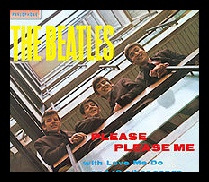
Their first-ever album, Please Please Me is raw and rough and still very rock & roll. Having already scored two hits when this appeared, Lennon and McCartney were only just beginning to flex their writing muscles and so relied heavily on the cover material to see them through. Their insecurity about their own abilities seems curious in hindsight since they'd pulled the title song and "I Saw Her Standing There" (with thanks to Little Richard) out of their hats. But they were an unknown quantity, still to launch a million bands and take pop music to places it had never dreamed off. A small step for four men, a giant leap for music. --Chris Nickson
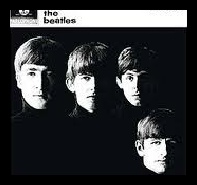
They still had plenty of covers to fill out the running time, but the Lennon-McCartney writing team was gathering steam and beginning to knock out pop classics as if they were pulling them out of thin air. "All My Loving" and "I Wanna Be your Man" come from this record, issued hurriedly to capitalise on Beatlemania. But even when they were laying into some classic Chuck Berry, by this time the Beatles had acquired a unique sound in the blend of John's and Paul's voices, while George was coming on by leaps and bounds as a guitar player. While not absolutely essential, as a snapshot of a band in a place and time, With the Beatles is good for a smile. --Chris Nickson
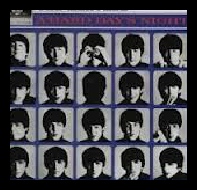
Strummmmm! That dramatic guitar chord that kicks of A Hard Day's Night (album, song, movie) still jumps right out at you, slaps you in the face, and jump-starts your heart. And you know what? Both the music and the film are still as crisp and lively as they were in 1964. Of course, only the first seven songs are actually in the movie (and they are the strongest of the bunch, from the rousing rock & roll of title track and the hit single "Can't Buy Me Love", to the beautiful ballads "If I Fell" and "And I Love Her"). But nobody's going to complain about having songs like "I'll Cry Instead" and "Things We Said Today" in the second half of the record; they certainly don't feel like leftovers. Yet another high-point for John, Paul, George, and Ringo--four fab fellows who hit the highest heights imaginable. --Jim Emerson
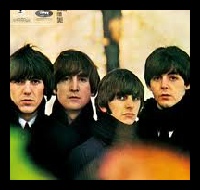
Banged out in a hurry for the 1964 Christmas market, Beatles for Sale sometimes sounds it, loaded with ill-conceived covers and some of John Lennon's most self-loathing lyrics. On the other hand, the people doing the banging-out were the Beatles, whose instincts for what worked musically were so strong that they could basically do no wrong--any record that has "Baby's in Black", "I Don't Want to Spoil the Party" and the delectable "Eight Days a Week" on it is only "minor" in the most relative sense. And, though their voices had been frazzled a bit by constant touring, they revved them up for some joyous shouting, and indulged their fondness for American country in subtle, playful ways. --Douglas Wolk
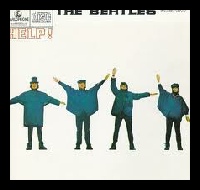
How John Lennon's confessional song became the title for a silly James Bond spoof is still inexplicable. The funny thing is, it works both ways--as a young man's personal statement about learning to open up to others, and as the frantic theme for an exotic espionage chase comedy starring those loveable mop-tops (this time in COLOUR). Like A Hard Day's Night, only the first "side" of this album actually contains songs from the movie--the biggest hits being the eponymous cry for assistance and "Ticket to Ride". But part two has a few nice tunes as well, like "It's Only Love", "I've Just Seen a Face" and a little ditty called "Yesterday". And it's always fun when they do an all-out screamer like "Dizzy Miss Lizzy", which sounds like John's raucous answer to Paul's "Kansas City / Hey, Hey, Hey, Hey" vocal on Beatles for Sale. --Jim Emerson
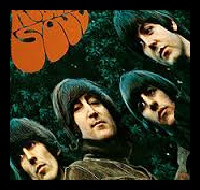
Rank 'em how you like, Rubber Soul is an undeniable pivot point in the Fab Four's varied discography no matter where, or how, you first heard it. So many classics: "Drive My Car" and "Nowhere Man" merge the early combustible Beatifics to a burgeoning studio consciousness; "The Word" can be read as a pre-psych warning shot; the sitar-laden "Norwegian Wood" and the evocative "Girl" (the latter written on the last night of the sessions) stand as turning points in John Lennon's oeuvre. George finally emerges too, with the McGuinn-ish "If I Needed Someone". --Don Harrison
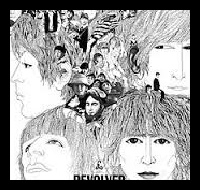
Revolverwouldn't remain the Beatles' most ambitious LP for long, but many fans--including this one--remember it as their best. An object lesson in fitting great songwriting into experimental production and genre play, this is also a record whose influence extends far beyond mere they-was-the-greatest cheerleading. Putting McCartney's more traditionally melodic "Here, There and Everywhere" and "For No One" alongside Lennon's direct-hit sneering ("Dr. Robert") and dreamscapes ("I'm Only Sleeping," "Tomorrow Never Knows") and Harrison's peaking wit ("Taxman") was as conceptually brilliant as anything Sgt. Pepper attempted, and more subtly fulfilling. A must. --Rickey Wright
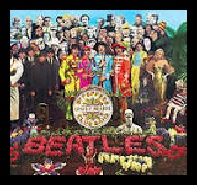
Before Sgt. Pepper's, no one seriously thought of rock music as actual art. That all changed in 1967, though, when John, Paul, George and Ringo (with "A Little Help" from their friend, producer George Martin) created an undeniable work of art which remains, after 3-plus decades, one of the most influential albums of all time. From Lennon's evocative word/sound pictures (the trippy "Lucy in the Sky With Diamonds", the carnival-like "Being for the Benefit of Mr. Kite") and McCartney's music hall-styled "When I'm 64", to Harrison's Eastern-leaning "Within You Without You", and the avant-garde mini-suite, "A Day in the Life", Sgt. Pepper's was a milestone for both 1960s music and popular culture in general. --Billy Altman
The White Album was meant to be the record that brought the Beatles back to earth after three years of studio experimentation. Instead, it took them all over the place, continuing to burst the envelope of pop music. Lennon and McCartney were still at the height of their songwriting powers, with Lennon in particular growing into one of music's towering figures. But even McCartney could still rock, and the amazement on "Helter Skelter" was that he had vocal cords at the end. From Beach Boys knock-offs to reggae and to the unknown ("Revolution #9"), this has it all. Some records have "legend" written all over them; this is one. --Chris Nickson
To the horror of their most obsessive fans, the surviving Beatles have proven more than willing to tamper with their pop legacy, as witnessed by the various facets of their massive, occasionally myopic mid-1990s Anthology projects (and the suspect notion of its faux techno-marvel "reunions"). In boldly revamping the soundtrack to their 1968 Heinz Edelmann-designed animated fable Yellow Submarine, the Fabs have shown they're not immune to the irony of the age either: their original involvement in the project was both tentative and minimal. This new version completely excises Beatles-producer Sir George Martin's charming, if sometimes maudlin, orchestral score, offering instead a new "songtrack" containing all the Beatles songs (standout cuts from Rubber Soul, Revolver, and Sgt. Pepper's Lonely Hearts Club Band, in addition to the four originals unique to the project) featured in the film. The pre-announced "unreleased song" on the set turns out to be the original album's rollicking "Hey Bulldog", one of the last true Lennon-McCartney collaborations. "Hey Bulldog" was also the subject of both a previously excised sequence in the film and a newly edited in-studio video cobbled together from footage shot in early 1968 and previously used in vintage promos for "Lady Madonna". Though it may further upset purists, the band has allowed these tracks to be digitally remixed and remastered into 5.1 surround sound, imparting both a stunning clarity and a new perspective (as well as restoring a "missing" verse and the original six-minute plus playing time to "It's All Too Much") on some of the greatest--if obviously overexposed--songs and recordings in the history of rock. --Jerry McCulley
The Beatles' last days as a band were as productive as any major pop phenomenon that was about to split. After recording the ragged-but-right Let It Be, the group held on for this ambitious effort, an album that was to become their best-selling. Though all four contribute to the first side's writing, John Lennon's hard-rocking, "Come Together" and "I Want You (She's So Heavy)" make the strongest impression. A series of song fragments edited together in suite form dominates side two; its portentous, touching, official close ("Golden Slumbers" / "Carry That Weight" / "The End") is nicely undercut, in typical Beatles fashion, by Paul McCartney's cheeky "Her Majesty", which follows. --Rickey Wright
The Beatles' original 1973 compilation 1962-1966 ("Red") and 1967-1970 ("Blue") have been remastered by the same dedicated team of engineers at EMI Music's Abbey Road Studios responsible for remastering The Beatles' original UK studio albums, carefully maintaining the authenticity and integrity of the original analogue recordings. The result is the highest fidelity the catalogue has seen since its original release.
This superb compilation, often called "the red album", brings together the majority of the Beatles' hits from the early to mid 60s. Consequently, it plays like an overview of some of the most popular and indelible rock songs of all time. From the "yeah, yeah, yeah"'s of "She Loves You" through the amped-up giddiness of "I Want to Hold Your Hand", the minor-key melodicism of "And I Love Her", and on to the chiming power pop of "Eight Days a Week" and the tweaky feedback of "I Feel Fine", these are the songs that turned the entire Western world on its ear.
The companion piece to the 1962-1966 singles compilation, this set (often called "the blue album"), as opposed to its chronological predecessor "the red album"), brings together the Beatles best known songs from 1967 through 1970. The Beatles were fiercely, relentlessly experimental during these years, and the swirling, visionary soundscapes of "Strawberry Fields Forever", which opens the collection, sets the tone with its effects-heavy production and backward tape loops. John Lennon's psychedelic songwriting, which emphasised crystalline melodies and surreal wordplay, can be heard on tracks like "Lucy In the Sky With Diamonds" and "Across the Universe". Paul McCartney's fascination with English music hall and novelty numbers is clear on "Penny Lane" and "Ob-la-Di, Ob-la-Da", and the set also has some of his finest ballads, including the mega-hits "Let It Be" and "Hey Jude". George Harrison emerged as a fine songwriting talent during these years with "Something" and "Here Comes the Sun". Yet despite evidence of their diverging individual directions, the Beatles still rock as a band on cuts like "Revolution". (The set includes the single versions of "Revolution", "Lady Madonna", and "Hey Jude"). The Beatles set the tenor of the late-'60s with this spectacular soundtrack, and it remains--even after years of overplaying--original, beautiful music.
Nearly 50 years after the historic live performances of The Beatles on The Ed Sullivan Show, those legendary appearances are now all yours to own on DVD.
This digitally remastered two disc edition runs to over four hours, complete with all 15 songs performed by the band over the four appearances on the Ed Sullivan Show, including: "I Want To Hold Your Hand", "Help" and "Yesterday" and available to view with a brand new 5.1 surround soundtrack and carefully restored video.
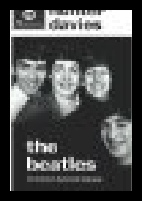
There’s only one book that ever truly got inside the Beatles and this is it. The landmark, worldwide bestseller that has grown with the Beatles ever since. During 1967 and 1968 Hunter Davies spent eighteen months with the Beatles at the peak of their powers as they defined a generation and rewrote popular music. As their only ever authorised biographer he had unparalleled access – not just to John, Paul, George and Ringo but to friends, family and colleagues. There when it mattered, he collected a wealth of intimate and revealing material that still makes this the classic Beatles book – the one all other biographers look to. Hunter Davies remained close with the band and as such has had access to more information over the years. This 40th anniversary edition contains new material which has never been revealed before, from the author's archives and from the Beatles themselves, that will bring new insights to their legend.


















 60's Quiz