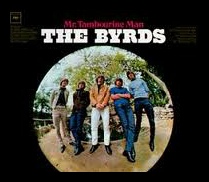
Few debut singles in the history of rock & roll have had the immediate and overwhelming impact of The Byrds' version of Bob Dylan's "Mr. Tambourine Man". Marrying a Beatles-like electric jangle to Dylan's insight and folky melody (in many ways, breaking Dylan into the pop market), it not only forecast the band's influence on the future of pop music but re-established an American rock & roll presence in the face of the British Invasion. The album of the same name, released in June of 1965, was a shotgun blast before the canon roar that Dylan's HIGHWAY 61 REVISITED (released just two months later) would become. As much as Bob Dylan was an overwhelming influence on the young Byrds--four of the twelve tracks on MR. TAMBOURINE MAN were Dylan songs--his contributions were only a part of what made the band special. The chiming sound of McGuinn's 12-string guitar was the group's backbone, characterising The Byrds' presence in a way few rock instrumentalists had done until then. Gene Clark proved to be a mighty songwriter in his own right--"I'll Feel A Whole Lot Better" has stood the test of time better than any other track here. Yet, what distinguished The Byrds and MR. TAMBOURINE MAN most was that they couldn't be easily pigeonholed. Combining disparate musical backgrounds and openly reconstructing everything from a British wartime standard ("We'll Meet Again") to a Jackie DeShannon pop tune ("Don't Doubt Yourself, Babe") in their own open-minded image, the Byrds kicked down the door to a new sound called folk-rock. Many would soon follow.
Arriving just months after the folk-rock call to arms of their brilliant debut, the Byrds' second album closely follows the same formula, but what a formula: durable American folksongs (from Pete Seeger, Bob Dylan, and even Stephen Foster) and their own strong originals are laced with the band's keening vocal harmonies and chiming guitars in a mix since institutionalised as a perennial rock dialect. With Seeger's classic title song, the Byrds brought Ecclesiastes onto the charts, importing the urban folk movement's social and political consciousness to the pop mainstream. If the album couldn't repeat the revelatory impact of its predecessor, it's still an earful, from Gene Clark's urgent, ardent "It Won't Be Wrong" to Dylan's contemplative "Lay Down Your Weary Tune". Meticulously remastered, this restored version also boasts unreleased tracks and B-sides, including "She Don't Care About Time", noteworthy for a 12-string solo lifted from Bach. --Sam Sutherland
This is the album on which The Byrds truly exploded. They had already introduced the mainstream to a young folk singer named Bob Dylan by taking an electrified "Mr. Tambourine Man" to #1. They introduced California folk-rock to the masses, breaking ground for the likes of the Mamas & Papas and the Turtles. With FIFTH DIMENSION, The Byrds planted the seeds of psychedelia--and not just the San Francisco kind--in pop culture. The grey, dark trip of the Velvet Underground and the fuzzed-out minimalist boogie of such garage heroes as Count Five and the 13th Floor Elevators can also be found within these grooves. FIFTH DIMENSION recognised that musical higher consciousness had to be manifested in a dark side as well as a brighter one. Gene Clark's departure from the band prior to these recording sessions, and the decision not to cover any Bob Dylan songs, streamlined the Byrds' sound and made the group's vision clear. "Eight Miles High", a highly-charged sonic release, evokes both VU's "Heroin" and John Coltrane's jazz explosions. The higher consciousness of "Eight Miles High", the harmony-driven stomp of "2-4-2 Fox Trot", and the CCR-meets-Stax boogie of "Captain Soul", all drenched in heavy guitar distortion, were unlike anything the pop world had heard. For the next three years, sounds inspired by FIFTH DIMENSION would make up the soundtrack of a cultural revolution.
Released in April 1967, months before the Summer of Love, YOUNGER THAN YESTERDAY was proof that The Byrds had already graduated from their fascination with the psychedelic "scene". "Eight Miles High" may have introduced the general public to the counter culture's interests and fascinations, but this song cycle found The Byrds reluctant to rest their faith in either the growing movement they helped bring together, or the art form that was the movement's voice. The sonic lessons they'd learned still infused many of the tracks. Tape-loops created the splendorous backdrop of "Mind Gardens", the Eastern modes used on "Eight Miles High" reappeared on the re-recorded "Why", and "C.T.A.-102" seemed less a song than an excuse to use the studio as a laboratory for new sounds. But a new direction was emerging. "So You Want To Be A Rock 'N' Roll Star", a tongue-in-cheek treatise on fame, and Bob Dylan's "My Back Pages", the best known tracks here, both hinted at a revaluation of previously settled matters. David Crosby's folky, Eastern-tinged "Everybody's Been Burned" may have been written well before he joined the group, but it is a dark declaration on moderation, trust and responsibility, that comfortably fits within the context of the era. And Chris Hillman's country-minded contributions not only grounded The Byrds with a salt-of-the-earth feel missing from the rest of the album, but hinted at the Nashville sound where they and many of their psychedelic brethren would soon end up. Now, as then, YOUNGER THAN YESTERDAY seems like the precursor to a generation's truer awakening.
The Notorious Byrd Brothers captures the Byrds between the seminal folk-rock glories of their better-known mid-1960s triumphs and the equally influential country-rock that would soon follow, but the album is no holding action: with one time Beach Boy associate Gary Usher producing and Roy Halee engineering, the band weaves its signature vocal harmonies and chiming guitars through a lusher, more impressionistic art-pop tapestry that stops just short of post-Sgt. Pepper's cliché, employing phased vocals, sound effects, Moog synthesiser, and horns. Thematically, the project pits utopian innocence ("Tribal Gathering", "Dolphins Smile") against a new wariness ("Artificial Energy", a cautionary look at amphetamines, and the Vietnam vignette of "Draft Morning"). In a field of well-paced, inventive songs, the zenith is the silken, wistful "Goin' Back", Carole King's poignant meditation on childhood and innocence. --Sam Sutherland
In the same year that Bob Dylan stepped back from his electric pilgrimages by releasing an album of roots-oriented morality tales, the Byrds took a symbolic flight to Nashville. Gone was Roger McGuinn's singular 12-string guitar sound and the acid rock that had had an effect on everyone from the Monkees to the Velvet Underground. McGuinn now played banjo, and bassist Chris Hillman doubled on the mandolin, both seemingly reconsidering their musical approaches. And while Dylan remained the songwriter of choice, his tunes now sat alongside a rearranged hymn ("I Am a Pilgrim"), a bluegrass version of a famous outlaw tale (Woody Guthrie's "Pretty Boy Floyd"), and a cover of the Louvin Brothers ("The Christian Life"). This was a musical turn, turn, turn, indeed. The obvious catalyst for all this reconstruction was the arrival of young Gram Parsons, and SWEETHEART OF THE RODEO played as if it was his coming-out party. He introduced Hillman and McGuinn to a musical world that seemed totally foreign to these predecessors of the Summer of Love, but one which lay a scant hundred miles outside their L.A. windows, in Bakersfield. Parsons' most important act was to help shape the overall sound of the album, but he contributed two original songs as well--"One Hundred Years From Now" and "Hickory Wind", a signature composition he'd record again. SWEETHEART OF THE RODEO caused an entire musical community to reconsider the musical traditions of America.
Dr. Byrds and Mr. Hyde
Possibly the most downcast of the Byrds' albums, DR. BYRDS reflects the mutation of the hippie dream that was taking place in 1968. The brutal slab of electric folk-rock that is Dylan/Rick Danko's "This Wheel's on Fire" opens things up, mirroring the sociopolitical upheavals of the time. On this and other tunes, guitarist Clarence White trades his sweet country licks in for some burning, semi-psychedelic licks. Though the pastoral side of the band is represented by gently jangling versions of "Old Blue" and "Your Gentle Way of LovingMe", the setting soon returns to disillusion and unrest. "King Apathy III", (which, along with "Candy", boasts some progressive time changes) is full of contempt and sadness for those deluded by the Age of Aquarius. The countrified "Drug Store Truck Drivin' Man" pounds a nail into the coffin of right wing hypocrisy. After all is said and done, the Byrds getback to the business of being a great bunch of musicians, amiably rocking their way through a medley that pairs a revamped "My Back Pages" with Jimmy Reed's blues classic "Baby What You Want Me to Do".
By 1969, the Byrds had already been through the Gram Parsons-fired country rock innovations of SWEETHEART OF THE RODEO,and had just lost Chris Hillman, the last original member except for Roger McGuinn. McGuinn was involved in so many extra curricular activities that he found little time to compose new material for EASY RIDER. His sole writing credit is the stellar title tune, co-written with Dylan for the famous biker film that gives this album its name (disliking the film,Dylan removed his name from the song). Fortuitously, McGuinn's taste in cover material and the compositional abilities of his bandmates more than made up for his lack of new material. McGuinn continued his experiments with combining old and new on an imaginative version of the traditional "Jack Tarr The Sailor", laced with synthesizer at a time when that instrument was barely being utilised in rock. Gene Parsons kicks in with one of the finest tunes of his career, "Gunga Din", a self-referential country-rocker that recalls the band's recent musical past. The balance of the album is a mixture of gentle folk-rock (Dylan and Woody Guthrie covers) and unabashed weirdness (the interstellar experimentalism of "Armstrong, Aldrin and Collins". All of it is eminently listenable.
The Very Best of the Byrds
Evoking memories of a bygone age when life was simpler and more melodic.The Byrds were one of the most underrated bands of the 60's. Featuring Gene Clark, David Crosby and Roger McGuinn recognisable by his 12 string Rickenbaker guitar. This compilation features 24 of the best tracks by this influential sixties band including 'Mr. Tambourine Man', 'Turn Turn Turn', 'Eight Miles High', 'My Back Pages', 'I'll Feel A Whole Lot Better', 'So You Want To Be A Rock 'N Roll Star', Chestnut Mare, 'Ballad Of Easy Rider' and more.



































 60's Quiz